shopify bfcm guide and checklist

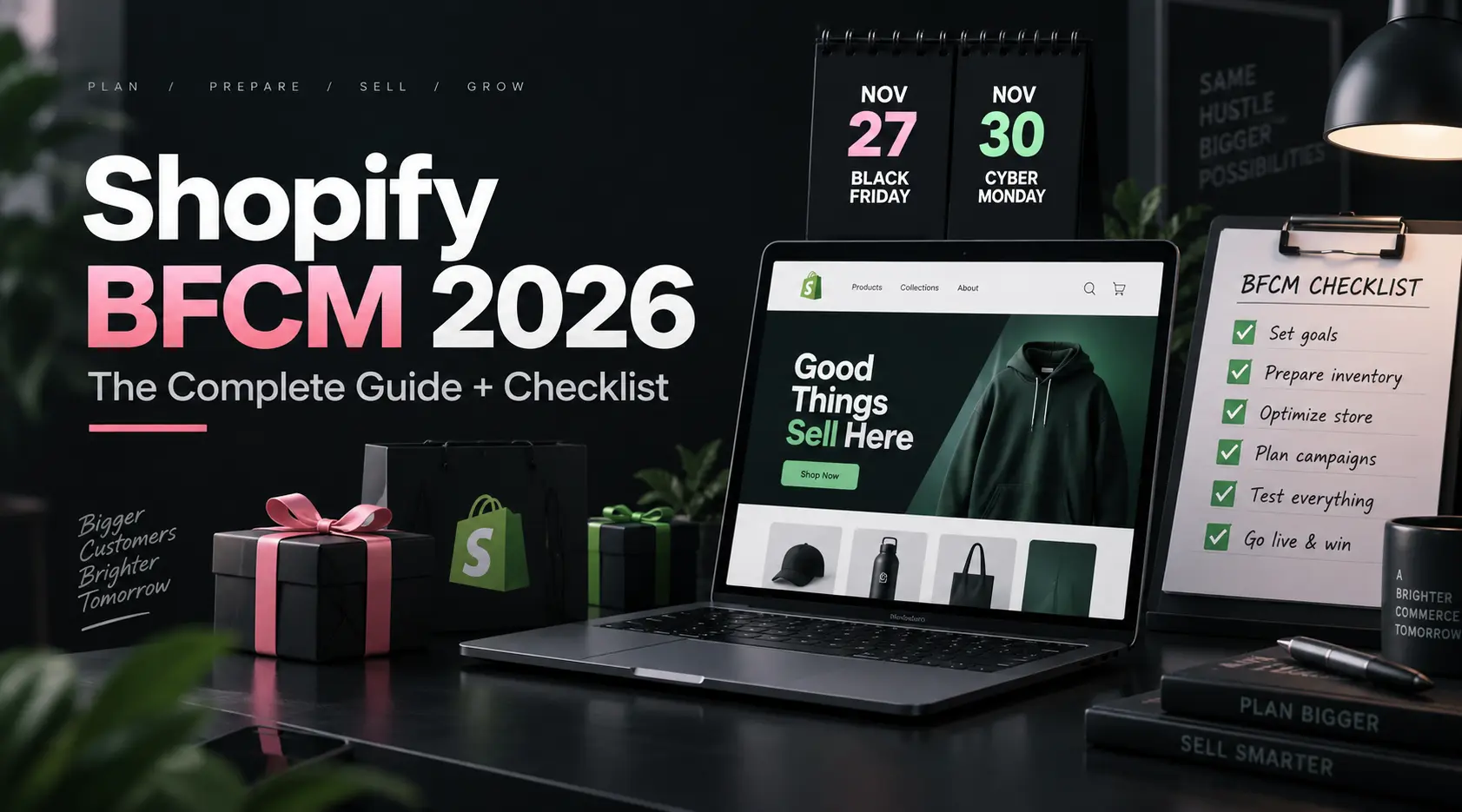
Shopify Black Friday Cyber Monday 2026: The Complete Guide + Checklist

On this page
On this page

Black Friday and Cyber Monday remain among the biggest sales opportunities of the year for Shopify merchants. During BFCM 2025, Shopify merchants generated a record $14.6 billion in global sales, up 27% year over year, while more than 81 million shoppers purchased from Shopify-powered brands. At the peak of Black Friday, sales reached $5.1 million per minute.

In 2026, Black Friday falls on November 27 and Cyber Monday on November 30. But BFCM preparation is no longer just about getting ready for one long weekend. Holiday shopping continues to spread across a longer period: during the 2025 holiday season, U.S. consumers spent more than $4 billion online on 25 separate days, compared with 18 days in 2024. Shopify also notes that merchants should plan for a longer sales period rather than waiting until Black Friday itself.

That means a successful Shopify BFCM campaign needs more than a last-minute discount. You need the right inventory, profitable offers, a tested storefront and checkout, prepared marketing campaigns, reliable fulfillment, and a clear plan for retaining the customers you acquire.

This Shopify BFCM checklist for 2026 walks you through what to prepare before, during, and after Black Friday and Cyber Monday, from campaign planning and inventory to promotions, store optimization, marketing, fulfillment, and post-BFCM retention.

Shopify BFCM 2025 Results: What They Mean for 2026

BFCM is not just a high-traffic sales weekend. It is also a stress test for your entire ecommerce operation: your offers, storefront, checkout, inventory, fulfillment, marketing, and customer support all need to work together under much heavier demand.

In 2025, more than 94,900 Shopify merchants had their highest-selling day ever during BFCM, while the average cart price reached $114.70. Shopify merchants also processed 16% of orders across borders, showing how important fulfillment, shipping communication, and international readiness can be during the event.

At the same time, shopping behavior is becoming more distributed across the holiday season. Adobe reported that U.S. consumers spent more than $4 billion online on 25 different days during the 2025 holiday season, up from 18 days the year before. That means merchants should prepare for demand before Black Friday itself rather than treating November 27 as the starting point.

For Shopify merchants, that preparation usually comes down to four priorities:

  • Protect profitability: Build promotions around your margins instead of relying only on deeper discounts.
  • Remove purchase friction: Make sure product pages, mobile UX, promotions, and checkout work correctly before traffic increases.
  • Prepare operations: Forecast inventory, fulfillment capacity, shipping deadlines, and customer-support coverage.
  • Plan beyond the first order: Use BFCM to acquire customers you can retain through post-purchase campaigns, loyalty offers, and future promotions.

That is why the rest of this checklist focuses on preparation across the entire customer journey, not just the discount you launch on Black Friday.

Shopify BFCM 2026 Timeline: When to Start Preparing

A strong BFCM campaign should be built well before Black Friday itself. In 2026, Black Friday falls on November 27 and Cyber Monday on November 30, but many merchants begin preparing weeks or months earlier. Shopify’s 2026 guidance also recommends treating BFCM as part of a longer holiday sales period rather than a single weekend.

Phase Timeline Key actions
Planning and strategy
Aug to Sep 2026 Key actions
  • Review 2025 BFCM performance: revenue, AOV, conversion rate, best sellers, and inventory gaps
  • Set 2026 revenue, margin, AOV, and conversion goals
  • Decide which products and collections will be featured
  • Choose your primary promotion strategy
  • Forecast inventory and confirm supplier lead times
Build your campaign
October 2026 Key actions
  • Create and configure discounts, bundles, BOGO offers, and free gifts
  • Build or update BFCM landing pages and sale collections
  • Prepare email, SMS, paid ads, social content, and creator assets
  • Confirm shipping policies, packaging, and fulfillment capacity
  • Start building your early access or VIP audience
Test and warm up
Nov 1 to 15 Key actions
  • Test every promotion, discount combination, and checkout flow
  • Review site speed, navigation, product pages, and cart on mobile and desktop
  • Confirm analytics, pixels, attribution, and conversion tracking
  • Start teasers, gift guides, and early access signups
  • Prepare customer support FAQs and response templates
Final checks and early access
Nov 16 to 26 Key actions
  • Launch VIP or subscriber early access if it is part of your campaign
  • Recheck inventory levels and promotion rules
  • Confirm shipping cutoffs and delivery messaging
  • Schedule email, SMS, social, and paid campaigns
  • Run a final test order from product page to confirmation email
BFCM live
Nov 27 to 30 Key actions
  • Monitor revenue, conversion rate, AOV, and cart abandonment
  • Watch inventory and pause promotions on products running low
  • Monitor checkout errors, discount issues, and support tickets
  • Review paid campaign performance and adjust budgets
  • Keep shipping and availability information up to date
Retention and follow-up
Dec 1 onward Key actions
  • Analyze campaign performance against your original goals
  • Identify your strongest offers, products, channels, and segments
  • Follow up with first-time BFCM buyers
  • Collect reviews and user-generated content
  • Run holiday, bounce-back, or loyalty campaigns
  • Document what worked and what should change for BFCM 2027

Shopify BFCM 2026 Checklist: 20 Things to Prepare Before Black Friday

Preparing for BFCM means coordinating more than promotions. Your inventory, storefront, marketing, fulfillment, support, and tracking all need to be ready before traffic peaks. The following checklist covers 20 areas to review before, during, and after BFCM 2026.

1. Analyze Your 2025 BFCM Performance

Before building your BFCM 2026 campaign, review what happened during BFCM 2025. Your own store data is more useful than relying only on industry benchmarks because it shows which products, offers, channels, and customer segments actually performed for your business.

Review:

  • Revenue: How much did you generate during the BFCM period?
  • Average Order Value: Which offers or products produced higher-value orders?
  • Conversion Rate: Which landing pages, collections, or campaigns converted best?
  • Best-Selling Products: Which SKUs or categories drove the most revenue?
  • Inventory Issues: Which products sold out too early or moved slower than expected?
  • Traffic Sources: Which channels brought the most qualified traffic?
  • Campaign Performance: Which email, SMS, paid, organic, or creator campaigns produced the strongest results?
  • Discount Performance: Which promotions generated revenue without putting too much pressure on margin?
  • Customer Mix: How much revenue came from new versus returning customers?
  • Checkout Drop-Off: Were there noticeable issues in cart or checkout during peak traffic?

Use these results to decide what to repeat, what to improve, and what to remove from your 2026 plan.

For context, Shopify merchants generated $14.6 billion during BFCM 2025, up 27% year over year, with an average cart price of $114.70. Use figures like these as benchmarks, but set your 2026 targets primarily from your own historical performance.

2. Set Your BFCM Goals and Budget

Before choosing your discounts or building campaign assets, define what you want BFCM 2026 to achieve. Your primary goal will affect the offers you run, the products you promote, and how you allocate your budget.

Set clear targets for metrics such as:

Revenue: How much do you want to generate during the campaign?
Average Order Value: Do you want shoppers to build larger carts?
Conversion Rate: Are you focused on converting more of your existing traffic?
New Customer Acquisition: How much are you willing to spend to acquire a new customer?
Profit Margin: What level of discount can your margins realistically support?
Repeat Purchases: How will you turn BFCM buyers into returning customers?

Then create a campaign budget covering paid ads, creators or affiliates, discounts, apps, additional inventory, fulfillment, and customer support.

Pro Tip: Don’t set your revenue target in isolation. Model how changes in traffic, conversion rate, AOV, discount depth, and margin would affect the final result.

3. Forecast Inventory and Prepare Fulfillment

Running out of a promoted product during BFCM can cut a campaign short, while overstocking can leave you with excess inventory after the sale. Before BFCM 2026, forecast demand at the SKU level and make sure your inventory and fulfillment capacity match the offers you plan to run.

Start with your 2025 BFCM performance, recent sales velocity, current inventory levels, planned discounts, and the products you expect to feature most heavily. Pay particular attention to bestsellers, bundle components, free gifts, and products included in paid campaigns.

Before launch:

  • Forecast demand by SKU: Use last year’s BFCM sales and recent product performance as a starting point.
  • Reserve inventory for promotions: Make sure products used in bundles, BOGO offers, and free-gift campaigns have enough stock to support the offer.
  • Confirm supplier lead times: Know how late you can reorder if a product sells faster than expected.
  • Stock packaging materials: Prepare enough boxes, mailers, labels, inserts, and other fulfillment supplies.
  • Plan fulfillment capacity: Confirm staffing, warehouse capacity, or 3PL coverage for peak order volume.
  • Set realistic shipping expectations: Publish clear processing times, delivery estimates, and holiday shipping cutoffs based on your actual carriers and fulfillment setup.
  • Monitor inventory during BFCM: Set low-stock alerts and be ready to pause or adjust promotions before key products sell out.

Pro Tip: If you have slower-moving inventory, consider pairing complementary products with stronger sellers in a bundle. Make sure the combination makes sense for the customer and still protects your margin rather than using bundles only to clear unwanted stock.

4. Choose Your Black Friday Deals, Discounts & Bundles

Your BFCM offer should support a specific business goal, not simply offer the biggest discount. Before setting up your promotion, decide whether you want to increase average order value, improve conversion, move inventory, acquire new customers, or reward loyal shoppers.

Depending on that goal, your Black Friday deal might include:

  • Product bundles to increase the value of each order
  • Tiered or volume discounts to reward larger purchases
  • BOGO offers to encourage customers to buy more units
  • Free gifts with purchase to add value without increasing the discount
  • Spend-and-save offers to encourage shoppers to reach a higher cart value
  • VIP or early-access offers for loyal customers

Keep the primary offer easy to understand. Running too many competing discounts at the same time can make the promotion harder to communicate and more difficult to test.

If you need more inspiration, see our 30 Black Friday Promotion Ideas for Ecommerce for bundle, discount, loyalty, gamification, and limited-time offer ideas.

Before finalizing the discount, check how it affects your margins. Use the Bundle Pricing Calculator to compare different bundle prices, customer savings, profit margins, and the sales lift needed to make the offer worthwhile.

5. Choose and Test Your BFCM Apps

BFCM is not the time to install critical apps for the first time. Review the tools your store depends on early, configure them before launch, and test how they interact with your theme, discounts, cart, checkout, analytics, and other apps.

Focus on tools that support the parts of your BFCM plan you actually need, such as promotions, email and SMS, post-purchase offers, reviews, fulfillment, or store optimization.

Here are six Shopify apps that can support different parts of your BFCM 2026 campaign:
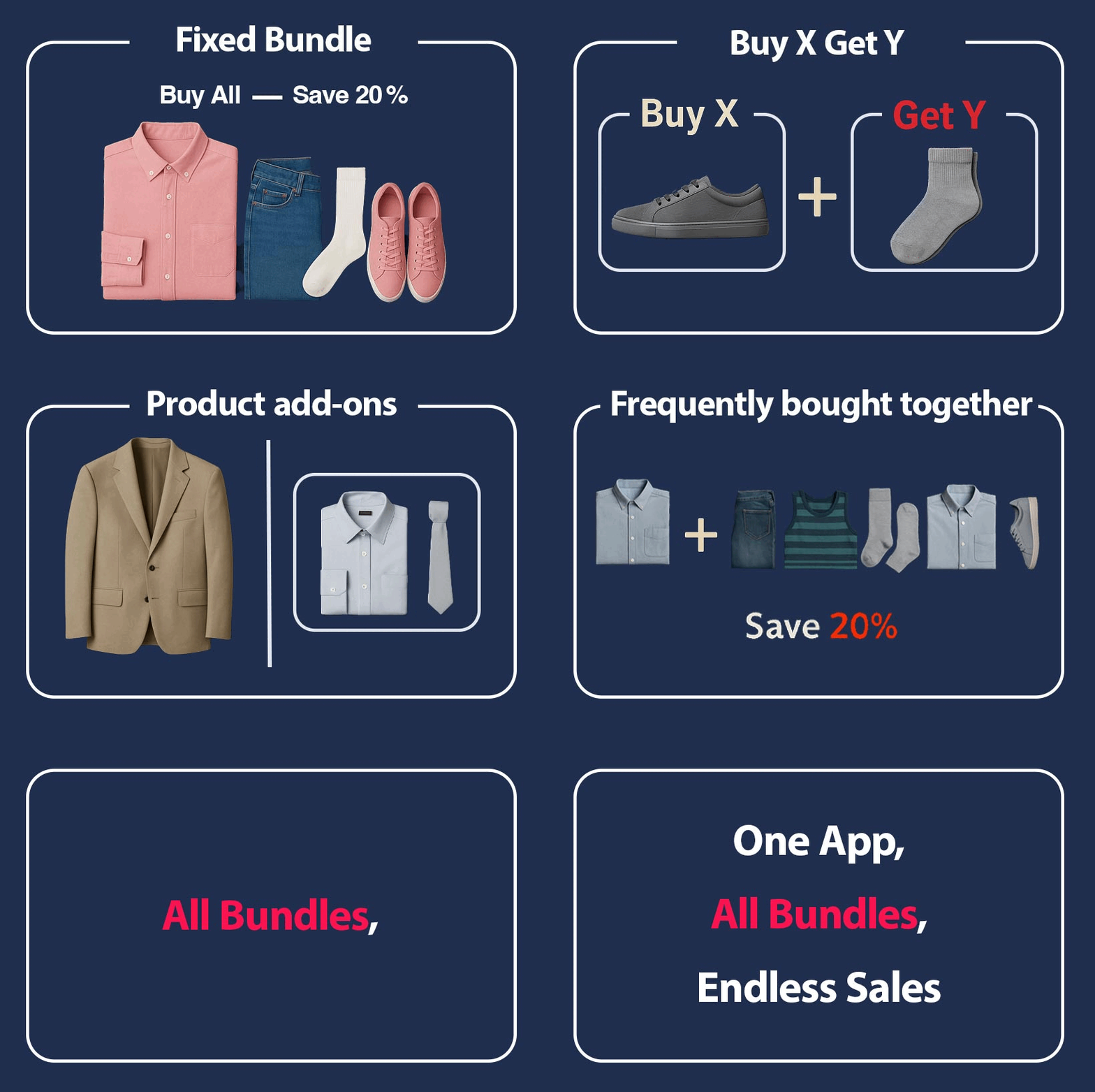
If increasing average order value is one of your BFCM goals, product bundles and quantity-based offers can encourage shoppers to add more to each order. Fast Bundle lets Shopify merchants create multiple bundle and upsell formats from one app.

    • Mix & Match Bundles – Let shoppers build their own bundles from a selected collection. Perfect for fashion, beauty, and accessories.
    • BOGO (Buy One Get One) – Classic Black Friday deal: “Buy 1, get 1 free” or “Buy 2, get 1 half off.”
    • Volume Discounts – Reward customers for buying more with tiered pricing, such as 10% off 3 items or 20% off 5.
    • Product Add-Ons – Offer complementary items, such as a phone case with a phone or serum with face cream, directly on the product page.


 Build Better BFCM Offers. Increase Order Value.

  • Klaviyo – Email & SMS Automation

Your email list is your most powerful BFCM channel. Klaviyo helps you cut through the noise with:

    • Teaser Campaigns – Build hype weeks before launch.

    • Countdown SMS – Send urgency-driven texts on Black Friday morning.

    • VIP Segments – Reward loyal customers with early access.

    • Automated Flows – Nurture leads before, during, and after BFCM.

  •   ReConvert – Post-Purchase Upsells

Don’t stop selling after checkout. ReConvert helps you maximize revenue with:

    • One-Click Upsells – Add offers directly to the thank-you page.

    • Exclusive BFCM Bundles – Show related items at a discount post-purchase.

    • Personalized Offers – Target upsells based on what shoppers just bought.

    • No Extra CAC – Boost revenue without increasing ad spend.

  •  yotpo Yotpo – Reviews & UGC

Trust is everything during BFCM. Yotpo builds it instantly with:

    • Review Carousels – Display ratings on product and landing pages.

    • User-Generated Content – Showcase customer photos for instant social proof.

    • Loyalty & Rewards – Encourage repeat purchases after BFCM.

    • Custom Widgets – Add credibility across your store in seconds.

  •  ship station ShipStation – Shipping & Fulfillment

More orders mean more fulfillment stress. ShipStation keeps everything under control:

    • Automated Labels – Print and process shipping faster.

    • Carrier Integrations – Access multiple carriers in one dashboard.

    • Bulk Order Management – Handle thousands of orders seamlessly.

    • Real-Time Tracking – Keep customers updated to reduce support tickets.
  • Plug in SEO Plug in SEO – Store Visibility & Performance

Even the best BFCM deals won’t matter if shoppers can’t find your store. Plug in SEO helps you stay visible and fix technical issues before traffic peaks:

    • SEO Audits – Detect broken links, missing tags, and hidden errors.

    • On-Page Fixes – Improve titles, meta descriptions, and headings for higher rankings.

    • Speed Checks – Identify scripts or apps that slow down your site.

    • Easy Reports – Get step-by-step recommendations to stay ahead of competitors.

Pro Tip for BFCM 2026

Don’t discount every product individually. Consider bundling slower-moving items with complementary bestsellers to create higher-value holiday offers while helping move excess inventory.

6. Test Your BFCM Discounts and Promotion Rules

Before BFCM goes live, test every discount, bundle, free gift, BOGO offer, and promotion rule exactly as a customer would experience it.

Check not only whether the discount appears, but also whether different offers interact correctly with each other. Problems often happen when multiple discount rules, bundle apps, automatic discounts, coupon codes, or eligibility conditions apply to the same cart.

Before launch, test:

  • Discount eligibility: Confirm the right products, collections, customers, and minimum spend requirements qualify.
  • Discount combinations: Check which promotions can and cannot be combined.
  • Bundle pricing: Make sure bundle discounts and individual product discounts do not create unintended pricing.
  • Free gifts and BOGO rules: Test qualifying quantities, gift availability, and removal behavior if the cart changes.
  • Automatic vs. code-based discounts: Confirm customers clearly understand whether they need to enter a code.
  • Mobile and desktop checkout: Run complete test orders on both.
  • Expired or invalid offers: Make sure customers receive a clear message when a promotion is no longer available.

Finally, place at least one complete test order from the landing page or product page through checkout and order confirmation before your campaign launches.

⚡ BFCM QA Tip

Create a simple test matrix for your main promotion scenarios before launch. Don’t test only the happy path — check what happens when a shopper qualifies, does not qualify, changes the cart, or combines multiple offers.

  • Standard order: No promotion applied
  • Qualifying order: Discount or offer applies correctly
  • Non-qualifying order: Promotion does not trigger
  • Multiple promotions: Check how discounts interact
  • Bundle or BOGO order: Confirm pricing and eligibility rules
  • Mobile checkout: Complete a full test order on a smaller screen

👉 Pro Tip: If you’re using Fast Bundle for BFCM, test your bundle offers alongside Shopify discounts and any other promotional apps before launch.

7. Optimize Your Website for Both Mobile and Desktop

Mobile plays a major role in holiday ecommerce, so your BFCM storefront needs to work smoothly across smartphones, tablets, and desktop devices. In the 2025 U.S. holiday season, 56.4% of online transactions took place on smartphones, according to Adobe Analytics.

Before BFCM, review the parts of your store that can create friction when traffic increases:

  • Test site performance: Use tools such as Google PageSpeed Insights and Shopify’s performance reports to identify slow pages, oversized assets, and unnecessary scripts.
  • Review mobile navigation: Make sure menus, filters, search, buttons, and promotional banners are easy to use on smaller screens.
  • Test product pages: Check image loading, variant selection, bundle widgets, sticky add-to-cart elements, and promotional messaging.
  • Run mobile checkout tests: Complete a real test order on multiple devices and confirm discounts, shipping options, payment methods, and form fields work correctly.
  • Compress heavy assets: Optimize large images, videos, animations, and campaign graphics before traffic peaks.
  • Check accessibility: Use readable font sizes, sufficient contrast, descriptive alt text, and clearly labeled buttons and form fields.
  • Remove unnecessary friction: Review pop-ups, app widgets, banners, and scripts that may block content or slow down the shopping experience.

Pro Tip: Test the exact pages your BFCM campaigns will send traffic to, not just your homepage. A fast homepage does not help much if the promoted product page, bundle page, or landing page is slow or difficult to use.

⚡ Best Practice Example

In 2024, a Shopify home décor brand shaved just 1.2 seconds off its mobile page load. The result? +14% conversion rate across BFCM weekend.

👉 Pro Tip: Image-heavy stores (fashion, jewelry, furniture) should compress files before uploading. Tools like TinyPNG or Shopify’s built-in optimizer can make a massive difference.

8. Prepare and Schedule Your BFCM Campaigns

Don’t wait until Black Friday week to build your marketing campaigns. Prepare your core email, SMS, paid ads, social content, and creator assets in advance so your team can focus on monitoring and optimization once BFCM begins.

Your campaign plan should cover the full BFCM journey:

  • Audience warm-up: Use teasers, gift guides, wish lists, and early-access signups to build interest before the main promotion.
  • Early access: Give VIP customers, subscribers, or loyalty members first access if it supports your strategy.
  • Black Friday launch: Clearly communicate the main offer, eligible products, promotion period, and any important conditions.
  • Weekend follow-up: Remind shoppers about the offer without repeating the same message across every channel.
  • Cyber Monday: Decide whether to continue the same promotion or introduce a different offer for November 30.
  • Last-chance messaging: Use a real campaign deadline to communicate urgency as the promotion ends.

Prepare your creative variations, audience segments, landing-page links, tracking parameters, and campaign schedule before launch. Then test every link and promotion before messages or ads go live.

⚡ BFCM Campaign Tip

Prepare your core email, SMS, paid ads, social content, and landing pages before BFCM begins so your team can focus on monitoring and optimization during the campaign.

👉 Pro Tip: Keep your messaging consistent across email, SMS, ads, social media, and landing pages. If an ad promises 20% off but the landing page shows a different offer or condition, shoppers may hesitate or abandon the purchase.

9. Update Your Store for BFCM

Your BFCM storefront should make the promotion easy to understand from the moment shoppers arrive. Update your key pages and navigation so customers can quickly find the products, bundles, and offers included in the campaign.
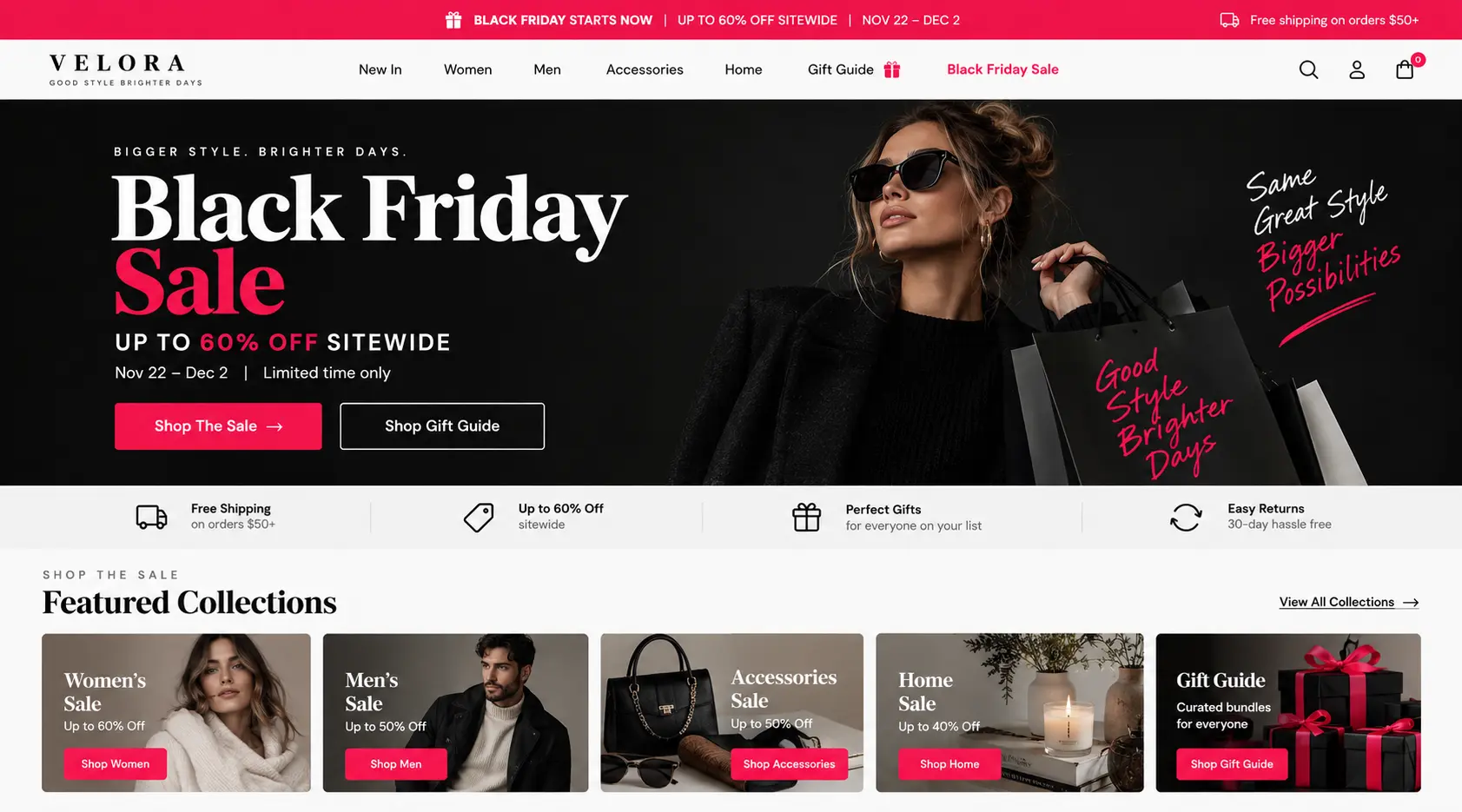
update your store for bfcm

Before launch:

  • Update homepage banners: Clearly show your main BFCM offer and campaign dates.
  • Create a dedicated BFCM landing page: Give paid, email, and social traffic a focused destination.
  • Highlight featured collections: Make sale products and bundles easy to discover from your navigation.
  • Keep your brand consistent: Use your campaign colors, typography, and creative style across ads, emails, and your storefront.
  • Show offer terms clearly: Explain minimum spend, eligible products, exclusions, and end dates where shoppers can see them.
  • Use countdown timers carefully: Only display countdowns tied to a real promotion deadline.
  • Check mobile layouts: Make sure banners, announcement bars, pop-ups, and promotional messages do not block important content on smaller screens.
BFCM Store Design Tip

Your seasonal design should help shoppers understand the offer quickly. Use campaign banners, announcement bars, and visual cues to highlight the promotion, while keeping the shopping experience simple and consistent with your brand.

👉 Pro Tip: Keep your design lightweight. Heavy images, videos, or animations can slow down important BFCM landing and product pages. Compress campaign assets before uploading them and test the final pages on both mobile and desktop.

10. Reward Loyal Customers with Early Access and VIP Offers

Your existing customers already know your brand, so BFCM is a good opportunity to reward them with benefits that go beyond the public sale. Instead of offering everyone the same promotion, consider giving loyal or high-value customers early access, exclusive products, or additional perks.


Ways to reward loyal customers during BFCM include:

  • VIP Early Access: Let loyalty members or high-value customers shop before the public campaign begins.
  • Exclusive Bundles: Create bundles, gift sets, or product combinations available only to selected customer segments.
  • Loyalty Bonuses: Offer bonus points, store credit, free gifts, or other rewards during the campaign.
  • Priority Perks: Consider free shipping, expedited shipping, or another benefit for your most valuable customers where operationally feasible.
  • Personalized Recommendations: Use previous purchases or browsing behavior to suggest relevant products and complementary offers.
  • Clear VIP Messaging: Make it obvious why the customer is receiving the offer and when their access or benefit ends.

Before launch, make sure your VIP segments, emails, SMS messages, landing pages, and promotion rules are tested just like your public BFCM campaign.

BFCM Loyalty Checklist

  • 👥 Segment Your VIP Audience: Include recent purchasers, loyalty members, and high-value customers.
  • 💌 Prepare VIP Messages: Create dedicated email and SMS campaigns for early access or exclusive offers.
  • 🎁 Set Up Exclusive Rewards: Prepare VIP-only bundles, free gifts, bonus points, or other perks.
  • Test Eligibility: Make sure the right customers can access the offer and the promotion rules work correctly.
  • 🚚 Clarify Terms: Clearly communicate shipping, returns, exclusions, and promotion conditions.
  • 📊 Track VIP Performance: Monitor conversion rate, AOV, and repeat purchase behavior from VIP traffic.
⚡ BFCM Loyalty Tip

Give VIP customers something genuinely different from the public sale. Early access, an exclusive bundle, a free gift, or bonus loyalty rewards can make the offer feel more valuable without requiring a deeper sitewide discount.

👉 Pro Tip: Create VIP-only bundles from relevant bestsellers or complementary products, and clearly communicate who can access the offer and when it ends.

Create VIP Bundles with Fast Bundle →

11. Prepare Your Customer Support Team

BFCM can generate a sudden increase in questions about discounts, orders, shipping, returns, and product availability. Prepare your support team before the campaign so customers can get clear answers without slowing down the shopping experience.

Before BFCM:

  • Prepare FAQ Responses: Create ready-to-use answers for common questions about discounts, bundles, shipping, returns, payment issues, and order changes.
  • Make Order Tracking Easy: Give customers a clear way to check order and shipping status without contacting support.
  • Brief the Team on Promotions: Make sure support agents understand your BFCM offers, eligibility rules, exclusions, and campaign deadlines.
  • Create an Escalation Plan: Decide who handles checkout issues, discount errors, app problems, refunds, or fulfillment delays.
  • Plan Support Coverage: Make sure enough team members are available during your busiest campaign periods.
  • Use Automation Where Helpful: Automated answers can handle repetitive questions, but customers should still have a clear path to human support when needed.
  • Check Every Support Channel: Test live chat, email, contact forms, social DMs, and any other channels you plan to use.

12. Plan Your BFCM Email and SMS Campaigns

Email and SMS can help you build anticipation before BFCM, announce your main offer, recover interested shoppers, and follow up after the sale. Prepare the core messages before the campaign begins so you are not writing and scheduling everything during BFCM week.

Your BFCM messaging plan can include:

  • Early-access messages: Give VIP customers or subscribers first access to your promotion.
  • Launch announcement: Clearly explain the main offer, eligible products, campaign dates, and important conditions.
  • Product and gift recommendations: Highlight bestsellers, bundles, gift sets, or products for specific customer needs.
  • Cart recovery: Remind shoppers about products they left behind while the promotion is still available.
  • Campaign reminders: Send relevant follow-ups during the weekend without repeating the exact same message every time.
  • Cyber Monday messaging: Decide whether Cyber Monday continues the same offer or introduces something different.
  • Last-chance reminders: Use the actual campaign deadline to communicate urgency.
  • Post-BFCM follow-up: Welcome new customers, request reviews, recommend complementary products, or introduce your next relevant offer.

Segment your audience where it adds value. For example, new subscribers, previous customers, VIP shoppers, recent purchasers, and customers interested in specific products may not need to receive the same message.

13. Optimize Your Product Pages for BFCM

Product pages are where much of your BFCM traffic turns into purchase decisions. Make sure shoppers can quickly understand the product, the promotion, and what they need to do to get the offer.
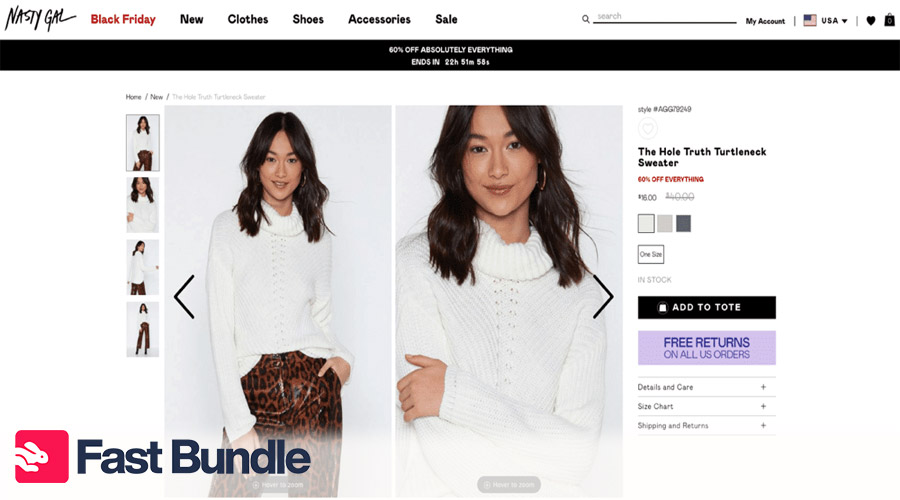
Before launch:

  • Make the offer obvious: Clearly show the discount, bundle savings, free gift, or other BFCM benefit near the main purchase area.
  • Explain promotion terms: Show minimum spend, eligible products, exclusions, and end dates where relevant.
  • Show bundle contents clearly: If you are selling a bundle or gift set, make it obvious what is included and how much the shopper saves.
  • Use accurate urgency signals: Only show low-stock messages or countdowns when they reflect real inventory or a real deadline.
  • Improve product information: Check images, descriptions, variants, sizing, compatibility, and other details customers may need before buying.
  • Clarify shipping and returns: Make delivery expectations and any BFCM-specific return conditions easy to find.
  • Test the mobile experience: Make sure variant selectors, bundle widgets, promotional messages, and Add to Cart buttons work properly on smaller screens.

14. Make Sure Your Store Is Strong for Traffic Surges

BFCM can bring a significant increase in traffic over a short period, so test the parts of your storefront that are most likely to affect performance before the campaign begins.

Shopify manages the hosting infrastructure for your store, so your focus should be on the elements you can control: your theme, apps, scripts, images, videos, and third-party integrations.

Before BFCM:

  • Test your key landing pages: Check the homepage, campaign landing pages, product pages, collection pages, and bundle pages.
  • Review app and script load: Remove unnecessary apps, tracking scripts, widgets, or third-party code that may slow down important pages.
  • Optimize campaign assets: Compress large images and videos before uploading them.
  • Test promotion widgets: Make sure bundles, discounts, pop-ups, announcement bars, and other BFCM elements load and work correctly.
  • Check third-party integrations: Confirm that payment, analytics, email, reviews, search, and other critical integrations are working.
  • Monitor store performance: Use Shopify’s performance tools and PageSpeed Insights to identify issues before traffic peaks.
  • Prepare a contingency plan: Know what your team should do if an important app, promotion, payment method, or integration stops working during BFCM.

Pro Tip: Avoid making major theme or app changes immediately before BFCM. Finish critical changes early enough to test the complete shopping journey before the campaign goes live.

15. Evaluate Your Checkout Process

A smooth checkout is essential during BFCM, especially when shoppers are comparing multiple offers and may be buying from mobile devices. Before launch, complete several test orders and make sure the checkout experience is clear, fast, and consistent with the promotion shown on your storefront.

Before BFCM:

  • Run full test orders: Test the complete path from product page to order confirmation.
  • Check mobile checkout: Make sure forms, payment options, shipping methods, and discount information are easy to use on smaller screens.
  • Verify payment methods: Confirm that your active payment options are available and working correctly.
  • Review shipping costs: Avoid surprising shoppers with unexpected shipping charges late in checkout.
  • Check taxes and duties: Make sure applicable charges are displayed clearly where possible.
  • Test discounts and bundles: Confirm that the final checkout total matches the offer shown on the product or landing page.
  • Review error messages: Make sure failed payments, invalid discounts, and unavailable shipping methods produce clear instructions.
  • Keep checkout messaging consistent: Campaign dates, discounts, free gifts, and shipping promises should match what customers saw before checkout.

📊 Check Your Store’s Conversion Rate

A smooth checkout means nothing if your store’s conversion rate is below industry average.
Use the free Shopify Conversion Rate Booster Tool to see how you compare and find quick wins.

👉 Check Conversion Rate Now

16. Plan Social Media Content & Ads

Your social and paid campaigns should support the same BFCM offer shoppers see on your website. Prepare your creative, audiences, tracking, and landing pages before launch so you can focus on optimization once the campaign is live.

Before BFCM:

  • Create platform-specific creative: Adapt your visuals and copy for Meta, TikTok, YouTube, Pinterest, or other channels you actively use.
  • Match ads to landing pages: Make sure the offer, price, dates, and promotion conditions in the ad match the page shoppers reach.
  • Prepare multiple creative variations: Test different hooks, formats, products, and offers rather than relying on one ad.
  • Build retargeting audiences: Prepare audiences for site visitors, product viewers, cart abandoners, and existing customers where appropriate.
  • Use creator content where relevant: Give creators clear briefs, campaign dates, approved messaging, product details, and tracking links.
  • Check tracking before launch: Verify pixels, UTMs, conversion events, and campaign naming conventions.
  • Plan your campaign sequence: Decide what runs during warm-up, early access, Black Friday, the weekend, Cyber Monday, and the final deadline.
  • Monitor creative fatigue: Watch performance during the campaign and rotate creatives if engagement or conversion begins to decline.

17. Set Up Your Abandoned Cart Recovery Plan

BFCM can bring a large number of high-intent shoppers who add products to their cart but do not complete checkout. Prepare your abandoned cart recovery flows before the campaign so you can follow up while the offer is still relevant.

Before BFCM:

  • Review your recovery flow: Make sure abandoned cart emails or SMS messages are active and sending correctly.
  • Match the current offer: The discount, bundle, free gift, or deadline in the recovery message should match the campaign the shopper originally saw.
  • Segment where useful: Consider different messaging for first-time shoppers, returning customers, high-value carts, or specific product categories.
  • Use real urgency only: Mention the actual campaign end time or genuine low-stock conditions instead of artificial countdowns.
  • Check links and cart restoration: Make sure shoppers can return to the right cart or product page without friction.
  • Avoid conflicting incentives: Do not automatically add a larger recovery discount if it undermines the main BFCM offer or your margin.
  • Test timing: Review performance and adjust send timing based on your own customer behavior instead of relying on one universal schedule.
  • Coordinate email and SMS: If you use both channels, avoid sending the same message too close together.

18. Prepare Backup and Contingency Plans for BFCM

Even with careful preparation, an app, payment method, promotion, shipping carrier, or third-party integration can fail during BFCM. Create a simple contingency plan before launch, so your team knows what to do if something goes wrong.

Before BFCM:

  • Keep a clean theme backup: Save a stable version of your theme before making final campaign changes.
  • Document critical app dependencies: Know which apps support your discounts, bundles, reviews, search, tracking, or other essential storefront functions.
  • Prepare payment alternatives: Confirm the payment methods you rely on and know what to check if one becomes unavailable.
  • Plan for promotion failures: Decide how your team will respond if a discount, bundle, free gift, or BOGO offer stops working.
  • Monitor platform and app status: Know where to check Shopify and critical app status during an incident.
  • Prepare for shipping delays: Have customer messaging ready in case a carrier or fulfillment partner experiences delays.
  • Assign escalation owners: Decide who is responsible for technical issues, payments, promotions, fulfillment, and customer communication.

19. Prepare Your BFCM Retargeting Campaigns

Not every shopper who visits your store before or during BFCM will purchase immediately. Set up your retargeting audiences and campaigns before launch so you can reconnect with shoppers who have already shown interest.

Useful retargeting audiences can include:

  • Product viewers: Shoppers who viewed specific products or collections.
  • Cart abandoners: Visitors who added products to their cart but did not complete checkout.
  • Previous customers: Existing buyers who may respond to relevant BFCM offers.
  • High-intent visitors: People who visited key landing pages or spent time exploring your campaign.
  • Engaged social audiences: Users who interacted with relevant campaign or product content.

Use channels that are already part of your marketing mix, such as Meta, Google, TikTok, email, or SMS where appropriate and consented.

Keep retargeting messages aligned with what the shopper previously saw. If they viewed a specific bundle or promotion, send them back to the relevant page rather than a generic homepage.

20. Set Clear Holiday Shipping Deadlines

BFCM shoppers often want to know whether their order will arrive in time for the holidays. Set and communicate shipping cutoffs based on your actual fulfillment capacity, carrier schedules, destination, and shipping method.

Before BFCM:

  • Confirm carrier cutoffs: Review the latest holiday schedules from the carriers you use.
  • Account for processing time: Include the time your team or 3PL needs to pick, pack, and hand off orders.
  • Set deadlines by shipping method: Standard and expedited shipping may need different cutoffs.
  • Consider destination: Domestic and international orders may require different deadlines.
  • Display deadlines clearly: Add relevant shipping information to product pages, checkout, FAQ pages, emails, and campaign messaging.
  • Update messaging if conditions change: If carrier delays or inventory issues affect delivery estimates, communicate the change quickly.

Shopify BFCM 2026 Trends & Predictions

BFCM in 2026 is being shaped by longer shopping windows, mobile-first buying, AI-assisted product discovery, and more personalized shopping experiences. These trends should not replace the fundamentals of a strong BFCM campaign, but they can influence how shoppers discover, compare, and purchase products.
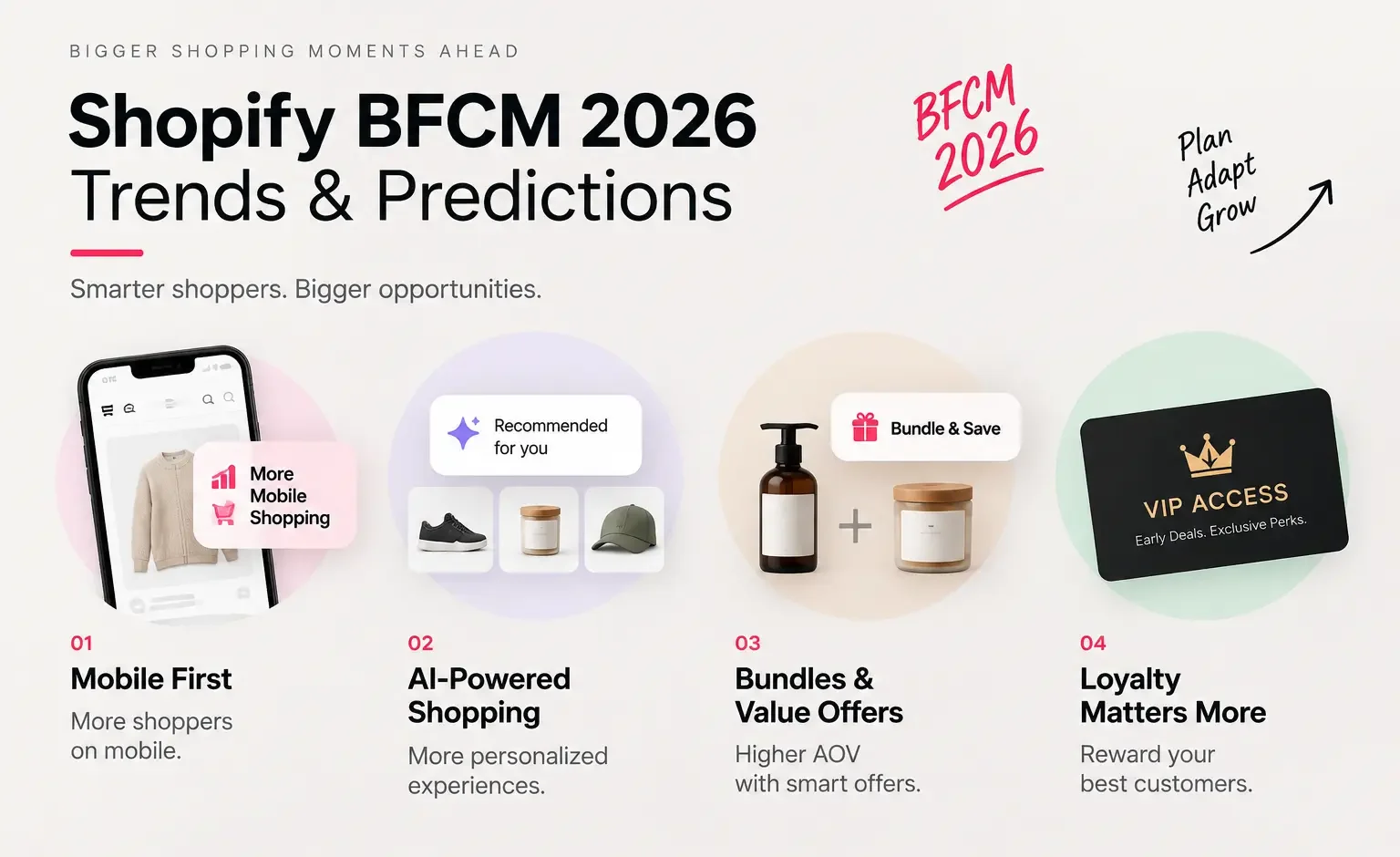
bfcm trends

  • AI Shopping and Agentic Commerce

AI is becoming a meaningful product-discovery and shopping channel. In Q1 2026, AI-driven traffic to Shopify stores grew more than 8× year over year, while orders from AI-powered searches increased nearly 13×.

Before BFCM, make sure your product titles, descriptions, prices, variants, inventory, bundle contents, and delivery information are accurate and easy for AI shopping assistants to understand.

  • Mobile-First Shopping

Mobile continues to play a major role in holiday e-commerce. During the 2025 U.S. holiday season, 56.4% of online transactions took place on smartphones.

Test your BFCM landing pages, product pages, bundle widgets, cart, and checkout on mobile before launch.

  • Earlier and Longer BFCM Campaigns

Holiday shopping is spreading across more days. In 2025, U.S. consumers spent more than $4 billion online on 25 separate days during the holiday season, compared with 18 days in 2024.

Plan your campaign as a longer journey rather than relying only on Black Friday itself.

  • Personalized Offers

Use customer data where appropriate to tailor recommendations, early-access offers, bundles, and messaging for different customer segments.

  • Creator and Social Commerce

Creator content, short-form video, and social commerce can help shoppers discover products before and during BFCM. Make sure creator offers and social campaigns lead to landing pages with matching pricing, products, and campaign terms.
Trends & Predictions: AI-Powered BFCM

Best Practice: In 2024, Shopify reported that stores offering bundles and upsells during BFCM saw an 8% higher average cart value compared to those that didn’t.

Pro Tip — Move Faster with Fast Bundle’s AI:

  • Bulk Edit with AI: Update bundle discounts across your catalog with a single prompt. Review changes before publishing.

  • AI Image Generator: Auto-generate on-brand images for new bundles so campaigns launch in minutes, not hours.

What to Do After BFCM 2026

  • Analyze Campaign Performance

Compare your final results with the goals you set before BFCM. Review revenue, conversion rate, AOV, margin, product performance, traffic sources, and campaign performance.

  • Follow Up With New Customers

Welcome first-time buyers, provide useful post-purchase information, and introduce relevant products or offers without immediately pushing another large discount.

  • Manage Inventory and Returns

Review what sold faster or slower than expected, process returns efficiently, and use the results to improve future inventory planning.

  • Collect Reviews and UGC

Ask satisfied customers for reviews, photos, or other user-generated content once they have received and used their purchase.

  • Plan Your Next Retention Campaign

Use appropriate post-BFCM offers such as loyalty rewards, store credit, replenishment reminders, or January comeback campaigns to encourage another purchase.

Turn Your BFCM Preparation Into Long-Term Growth

A successful BFCM campaign starts well before Black Friday and continues after Cyber Monday. Use your 2025 performance data to set realistic goals, prepare your inventory and offers, test your store, and make sure your marketing, fulfillment, and support teams are ready for BFCM 2026.

After the campaign, review what worked and use those insights to improve future promotions and customer retention.

Ready to Build Your BFCM Offers?

Create product bundles, BOGO offers, volume discounts, and other BFCM promotions with Fast Bundle.

Try Fast Bundle
Build and manage BFCM bundle offers from one Shopify app.

FAQ

Black Friday falls on November 27, 2026, and Cyber Monday falls on November 30, 2026.

Start strategic planning in late summer or early fall. Inventory, campaign assets, promotions, landing pages, and testing should be completed well before the final week of November.

Review your previous BFCM performance, set campaign goals, forecast inventory, choose your offers, test apps and discounts, optimize product pages and checkout, prepare marketing campaigns, and confirm shipping and support plans.

The right offer depends on your goal. Bundles and tiered discounts can help increase order value, BOGO offers can help move inventory, free gifts can add perceived value, and VIP offers can reward loyal customers.

Use product bundles, volume discounts, spend thresholds, complementary add-ons, or free gifts above a minimum order value. Check your margins before increasing discount depth.

Content Writer at Fast Bundle & eCommerce Content Specialist

Rozhan is a Content Writer at Fast Bundle, where she produces strategic, value-packed content to help ecommerce businesses (especially Shopify stores) grow their revenue through smart product bundling. Her work focuses on simplifying bundling techniques, enhancing customer experience, and sharing data-backed insights that drive conversions. With a passion for clear communication and a background in digital marketing, Rozhan turns complex ecommerce ideas into accessible, results-driven articles.